
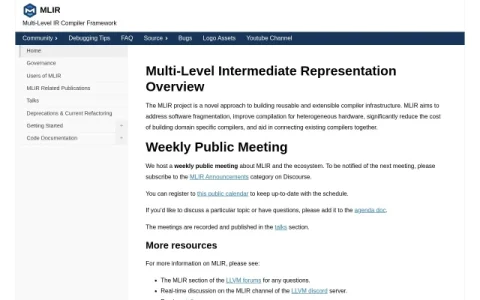
MLIR is a compiler infrastructure project hosted under the LLVM umbrella. It introduces a multi-level intermediate representation designed to be reusable and extensible, so different compilers and domain-specific toolchains can share a common foundation instead of rebuilding everything from scratch.
The core idea is the dialect: each dialect defines its own operations, types, and attributes, and multiple dialects can coexist in one module. This enables progressive lowering from high-level, domain-specific constructs down to low-level machine-oriented representations, with shared infrastructure for verification, transformation, and analysis.
MLIR targets compiler engineers, programming language researchers, and hardware vendors who need to build or connect compilers for heterogeneous targets. It is also relevant to teams maintaining domain-specific languages that want to reduce the cost of custom compiler development.
Getting started means reading the overview and language reference, then exploring the Python bindings and Doxygen API docs. The community offers a forum, Discord chat, a weekly public meeting with an agenda document, and recorded talks, which are useful for keeping up with ecosystem changes.
Overall, MLIR is a substantial framework rather than a turnkey product; teams should budget time for learning its dialect model and LLVM integration before committing to it.

评论与评分
0还没有评论,来写下第一条评价吧。