
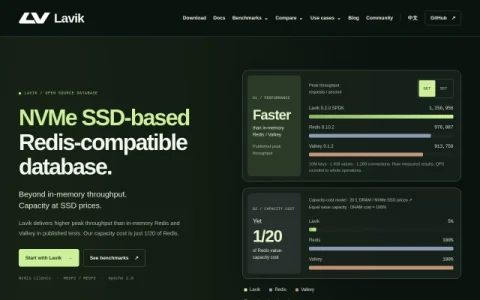
Lavik positions itself as a Redis-compatible database rather than a cache replacement in the traditional sense. Its distinguishing decision is to keep values on NVMe SSDs while preserving the Redis protocol surface, so applications built around RESP2 or RESP3 clients can connect without rewriting data-access code. The project is published under Apache 2.0, with source, documentation, and downloads available directly from the site.
The site’s core evidence is a benchmark section comparing Lavik 0.2.0 (SPDK) against Redis 8.1 and Valkey 9.1 on a 10-million-key, 1 KiB-value workload with 1,280 connections. Reported peak GET throughput reaches about 1.16M requests per second versus roughly 976K for Redis and 914K for Valkey, with p99.9 latencies in a similar range. A separate capacity-cost model argues that equal value capacity costs about 5% of an all-DRAM deployment.
Beyond raw numbers, the navigation covers comparisons, use cases, a blog, and a community section, plus a Chinese-language option. That structure suggests the intended audience is infrastructure and backend engineers evaluating storage-heavy key-value workloads — session stores, large object caches, or datasets that outgrow RAM budgets — rather than teams needing sub-millisecond in-memory latency above all else.
A practical approach is to start with the published benchmark methodology and cost assumptions before testing, since both depend on specific hardware and workload shapes. Teams should validate p99.9 late

评论与评分
0还没有评论,来写下第一条评价吧。