
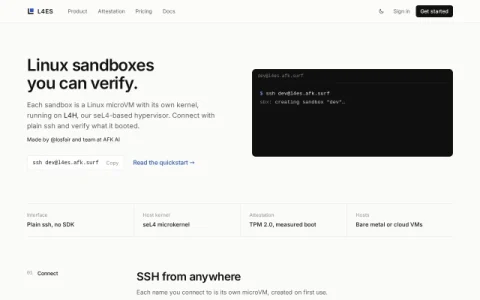
L4ES is a sandbox hosting service built around a verifiable isolation model. Instead of containers sharing a host kernel, each sandbox is a Linux microVM with its own kernel, running atop a hypervisor derived from seL4, a formally verified microkernel. The stated goal is to make the security properties of the environment checkable by the user rather than asserted by the operator.
Access is intentionally conventional: you connect with plain SSH, so existing keys, config files, and automation keep working. Each instance is TPM-attested, meaning the platform can produce evidence about what is actually running, which supports verification workflows. This combination of microVM isolation and attestation targets use cases where the integrity of the execution environment matters, such as running untrusted code or handling sensitive builds.
The service suits developers, security engineers, and infrastructure teams who need disposable or long-lived Linux environments with stronger boundaries than shared-kernel containers. It is also relevant to researchers evaluating isolation guarantees and to organizations with compliance requirements around workload separation. Users who mainly want a batteries-included application platform may find the offering too low-level.
A practical approach is to start with a single sandbox, confirm SSH access and key handling, then test the attestation flow to see what evidence is exposed and how it integrates with your existing verification tooling. Fro

评论与评分
0还没有评论,来写下第一条评价吧。