

BitFlux is a technical blog and documentation site focused on the performance characteristics of modern computer systems. Its centerpiece is the multi-part ‘Memory is slow, Disk is fast’ series, which examines how PCIe bandwidth, NVMe storage, and DRAM behavior interact in real workloads. The site also hosts docs, examples, support, and about pages, suggesting it is tied to a product or engineering effort around disk-based data structures.
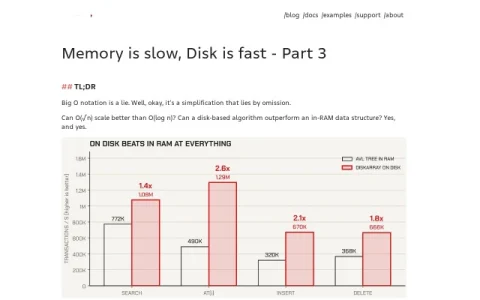
The core content combines benchmark results with architectural argument. Part 3 compares an AVL binary tree requiring 144 GiB of RAM at 2 billion nodes against a DiskArray that keeps data on 8 NVMe drives and uses only 264 MiB of RAM, yet remains faster across operations. Earlier parts cover widening CPUs, PCIe outpacing DRAM bandwidth, and streaming from disk beating page cache and DRAM buffers.
This material is aimed at systems engineers, database developers, and advanced computer science students who are comfortable with Big O notation, caching layers, and storage hardware. It assumes familiarity with performance profiling and is not intended as an introductory guide.
Use the series sequentially, since each part builds on prior benchmarks and definitions. Treat the claims as starting points for your own testing rather than universal rules, and check the docs and examples sections for implementation context. Overall, BitFlux is a niche but rigorous resource for engineers questioning conventional performance intuition.

Comments & Ratings
0No comments yet. Be the first to review.