

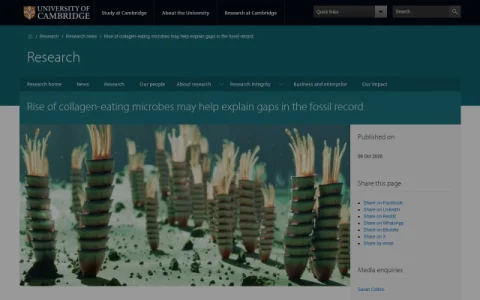
The page sits within the University of Cambridge’s research news section and reports on a peer-reviewed study about why some early animals were preserved as fossils while later soft-bodied creatures largely vanished from the record. It is an institutional news item, not a database or interactive tool, so the content is a written summary of findings attributed to the research team.
The central argument is that the evolution of microscopic organisms able to break down collagen, a structural protein in animal tissue, may have changed preservation conditions over time. The article contrasts mineralised shells, bones and teeth with fragile soft tissue, explaining why the fossil record is skewed toward hard parts and why the timing of collagen-eating microbes matters.
The page suits palaeontology and evolutionary-biology students, science journalists and curious general readers who want a short, authoritative account of a specific hypothesis. Because it is a news summary, those needing methods, figures or raw data should follow the linked paper and institutional repositories.
Use it as an entry point: read the summary for the core claim, then check the cited study for evidence and limitations. It is best treated as one dated news item within a broader research archive rather than a comprehensive reference on fossil preservation.




评论与评分
0还没有评论,来写下第一条评价吧。