
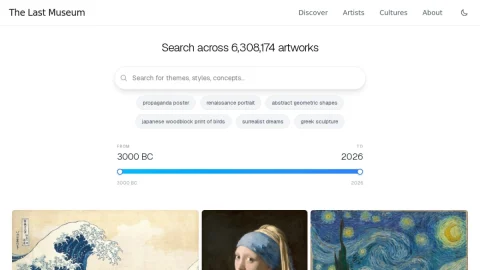
The Last Museum positions itself as a single entry point to the digitized holdings of the world’s great museums, with a corpus of roughly 6.3 million artworks. Rather than browsing one institution at a time, visitors search across collections, which makes it useful for comparative viewing and for tracing a motif across cultures and centuries.
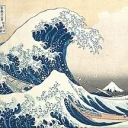
The core mechanism is semantic search: queries are matched by meaning rather than exact keywords, so phrases like “surrealist dreams” or “japanese woodblock print of birds” return plausible results. A date range filter spans 3000 BC to 2026, and the site also exposes Artists and Cultures entry points for browsing beyond search. A curated selection of well-known works, from Hokusai’s Great Wave to Vermeer and Van Gogh, anchors the landing page.
It fits students, art historians, designers, and writers who need visual references or starting points for research, as well as casual viewers who want to follow a theme across museum boundaries. Curators and educators may find it handy for assembling comparison sets before visiting official collection pages.
Because records are aggregated from many institutions, metadata quality and image rights differ by source; confirm details and licensing with the holding museum before publishing or reproducing anything. Use broad descriptive queries first, then narrow with the date range and artist pages.
In short, it is a discovery layer over public museum collections rather than a replacement for offici


评论与评分
0还没有评论,来写下第一条评价吧。