
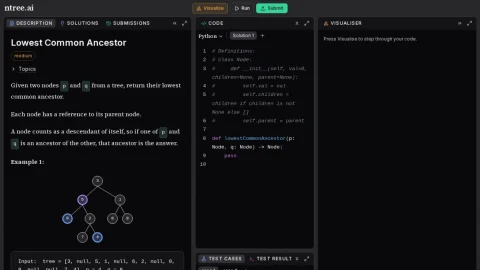
ntree.ai is an interactive platform for practicing algorithm and data structure problems. Each problem page provides a clear statement, examples, and constraints, and the site supports visualizing, running, and submitting code. The Lowest Common Ancestor page is one such problem, aimed at users who want to solve tree-related challenges in a hands-on environment.
The core feature of this page is the Lowest Common Ancestor problem itself. Given two nodes p and q from a tree where each node has a parent reference, the task is to return their lowest common ancestor. The page includes worked examples and notes that a node counts as a descendant of itself. Users can visualise the tree, run their code, and submit solutions for evaluation.
This problem is suitable for software engineering interview candidates, computer science students, and anyone reviewing tree algorithms. It is rated medium difficulty and has been solved and attempted by other users, making it a practical exercise for testing recursive or iterative approaches to ancestor queries.
To get the most from the page, read the description and constraints carefully, study the examples, then use the visualise and run features to test your logic before submitting. The parent-pointer structure suggests thinking about path-based or two-pointer solutions. Overall, ntree.ai provides a focused, interactive way to practice a classic tree problem.



Comments & Ratings
0No comments yet. Be the first to review.