
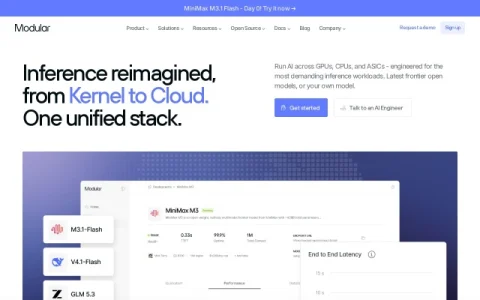
Modular positions itself as a unified inference stack rather than a single product. The company spans low-level GPU kernel development through to managed cloud serving, aiming to remove the layers of glue code that usually sit between a model and its production endpoint. Its stated goal is roughly 2x performance while running on both NVIDIA and AMD hardware.
The core offering combines MAX, a generative AI native modeling and serving engine, with Mojo, a systems language built for AI workloads. Around these sit shared and dedicated endpoints for frontier open models, support for custom models at kernel-level control, and deployment options ranging from Modular’s fully managed cloud billed by usage to running the stack inside your own VPC.
The model library covers text, image, video, audio, code generation, and agentic workloads, with names like FLUX.2 Klein, GLM 5.3, and MiniMax M3.1 Flash listed. Learning resources include an LLM inference handbook, the MAX LLM Book, Mojo Quest challenges, and Mojo GPU Puzzles, which suggests the company expects developers to engage with the stack directly.
This makes Modular most relevant to ML engineers, infrastructure teams, and platform builders who care about inference latency, hardware portability, and controlling their own serving path. Teams that just want a simple API can use the shared endpoints, while those with custom models or compliance needs can move to dedicated endpoints or a VPC deployment.
A practical approach is to sta


Comments & Ratings
0No comments yet. Be the first to review.