

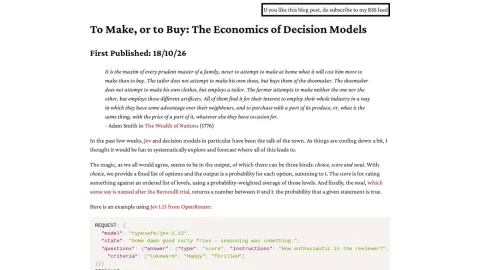
The article is a personal blog post that examines decision models through an economic lens, taking its cue from Adam Smith’s argument that one should never make at home what costs more to make than to buy. It uses this classic principle to frame how decision models like Jev should be understood and where they may be heading.
The core discussion centers on the outputs that decision models can produce, identified as choice, score, and noul, and on how decision hierarchies can be formalized with Chow’s reject rule. Rather than treating these models as black boxes, the post tries to systematically explore their structure and forecast their development.
The piece is aimed at readers with an interest in decision theory, model evaluation, and the economics of tooling, especially those following discussions around Jev. It assumes some familiarity with formal decision concepts and is not an introductory tutorial.
As a blog post, it is best read as a structured essay rather than documentation. Readers may benefit from reviewing the referenced concepts, such as Chow’s reject rule, alongside the text. Overall, it offers a thoughtful economic framing of how and when to rely on decision models.

Comments & Ratings
0No comments yet. Be the first to review.