
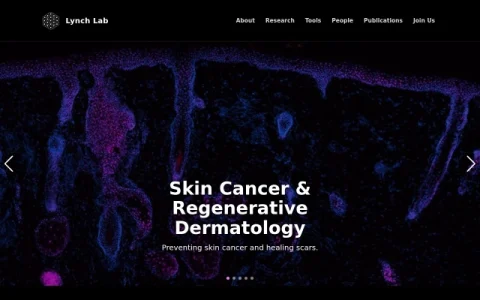
Lynch Lab is a research group based at St John’s Institute of Dermatology, King’s College London, on the Guy’s Campus. Its work centres on two persistent problems in dermatological surgery: stopping skin cancer before it develops and limiting scarring after injury or excision. The site presents the lab as a translational unit, moving from clinical questions toward mechanistic understanding and then toward therapeutic strategies, intellectual property and trials or industry partnerships.
The research is organised around four visible themes. One maps the tumour microenvironment in basal cell carcinoma to understand how keratinocytes and fibroblasts interact. Another develops non-invasive skin cancer detection that pairs AI with advanced imaging to reduce reliance on biopsy. A third studies fibroblast subpopulations to improve scarring and restore skin function, while a fourth uses 3-dimensional cell culture models to test preventive treatments.
Methodologically, the group combines single-cell genomics, spatial transcriptomics, non-invasive skin imaging, AI and organotypic cell culture. The site’s Tools section reflects this computational and imaging emphasis, and the Publications section gives visitors a way to check outputs before reaching out. People pages identify group members, which helps those looking for a specific supervisor or collaborator.
Prospective PhD students, postdocs and clinical researchers are the most likely audience, along with industry partners interest

Comments & Ratings
0No comments yet. Be the first to review.