
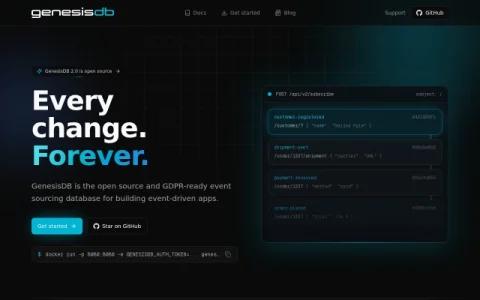
GenesisDB is positioned as an event sourcing database rather than a conventional relational or document store. Its premise is that every state change should be captured permanently as an event, giving applications a complete and auditable history. The project is open source under the MIT license and markets itself as GDPR-ready, which signals that data erasure and compliance were considered from the start.
The core interface is deliberately small. Developers commit events, fetch streams, run queries, subscribe to changes and erase data through plain HTTP requests, with JSON in and NDJSON out. No dedicated driver is required, so curl or any HTTP client works. Events follow the CloudEvents 1.0 specification, and a SHA-256 hash chain links records to support integrity verification. Server-Sent Events power subscriptions, and the build ships as a single static binary for Linux, macOS and Go embedding.
Operationally, GenesisDB fits containerized environments with Docker and Kubernetes images for amd64 and arm64, plus Prometheus metrics and OpenTelemetry tracing for observability. A built-in MCP server extends the database to AI tooling workflows. These choices suggest a team targeting cloud-native deployments where monitoring and integration matter as much as storage.
The primary audience is backend and platform developers who already understand event sourcing and want a lightweight, HTTP-first implementation without adopting a large ecosystem. It also suits teams with strict a


Comments & Ratings
0No comments yet. Be the first to review.