

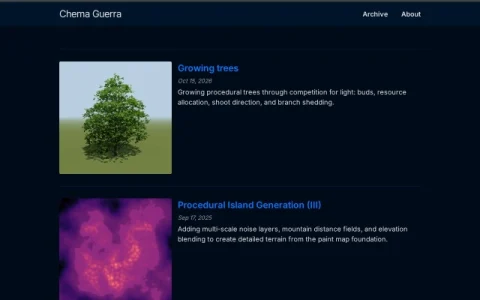
Chema Guerra’s site is a personal coding blog that functions as a working notebook. Posts document projects the author is developing, whether at work or as an independent researcher, and the through-line is computer graphics and physics simulation. Rather than news or tutorials, the archive reads as a chronological record of problems being solved, with each entry explaining the reasoning behind a technique.
The core content is technical and often serialized. Procedural Island Generation spans three posts, moving from Voronoi diagrams and Delaunay triangulation to paint-map terrain elevation, multi-scale noise layers, and mountain distance fields. Other entries cover procedural trees grown through competition for light, spherical harmonics for encoding radiance, truncated SVD, principal component analysis, and a multi-part series on constrained dynamics.
The site suits graphics programmers, physics simulation enthusiasts, and students who want to see how mathematical tools are applied in practice. Readers comfortable with linear algebra and geometry will get the most from the derivations, though the explanations are written to be followed rather than merely referenced.
Because posts are project-driven, the best approach is to pick a series and read it in order, starting with the foundational entry. The archive is small enough to browse chronologically, and older math posts provide useful background for the newer procedural generation work. Overall, it is a focused resource

Comments & Ratings
0No comments yet. Be the first to review.