

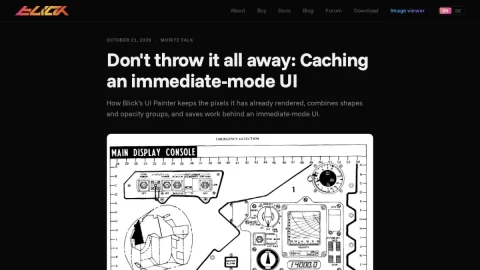
Blick is a native image viewer and UI toolkit whose blog covers the engineering behind its interface. This post addresses a common criticism of immediate-mode UI: that the interface description is rebuilt every frame, repeating work even when little has changed.
The article explains how Blick’s UI Painter retains pixels it has already rendered, combines shapes and opacity groups, and avoids redundant work behind an immediate-mode API. It also discusses the simplicity-versus-repeated-work tradeoff and why modern hardware often makes the cost negligible.
Beyond raw speed, the post considers power usage and the common approach of putting an application to sleep when idle, noting where that strategy suffices and where it becomes less clear. The discussion is aimed at developers building or evaluating UI rendering systems.
Readers already familiar with immediate-mode concepts will get the most from it, as it assumes knowledge of frame-based UI reconstruction. It works best as part of the broader Blick blog rather than a standalone tutorial.
Overall, it is a concise technical argument that immediate-mode UI need not waste work, illustrated with Blick’s own caching approach.



Comments & Ratings
0No comments yet. Be the first to review.