
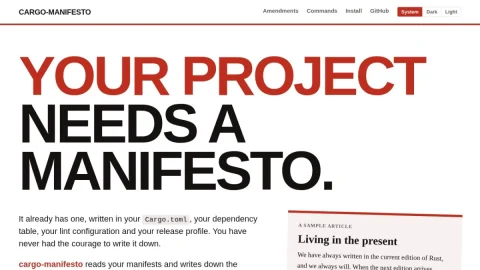
cargo-manifesto is a Cargo subcommand built around a simple premise: every Rust project already has a manifesto, implicit in its Cargo.toml, dependency table, lint configuration, and release profile. The tool reads those manifests and writes down the principles behind decisions the team has already made, making implicit conventions explicit without requiring a separate documentation process.
The core workflow is installation via cargo install cargo-manifesto –locked, followed by commands that generate and amend manifesto articles. It operates entirely offline and never builds, fetches, or edits your code, so it stays out of the build pipeline. The generated document is treated as a build artifact: if the principles disagree with the code, the principles are considered out of date and are regenerated after changes.
The tool fits Rust maintainers and teams who want a lightweight, code-derived record of project doctrine. It is especially useful for projects with established conventions around editions, dependencies, lints, and release profiles, where new contributors need a concise statement of how decisions are made. It is less relevant for projects without stable conventions or for non-Rust codebases.
To use it, install the subcommand and run it against an existing project to see what principles are already encoded. Review the generated articles, amend them where clarification is needed, and regenerate after meaningful configuration changes. Treat the output as a living ar


Comments & Ratings
0No comments yet. Be the first to review.