

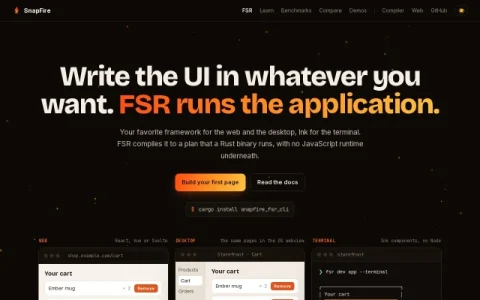
SnapFire is built around a single idea: keep the UI authoring experience you already know, but change what runs underneath. You write pages in React, Vue, Svelte, or Ink, and the FSR compiler turns that into a plan that a Rust binary executes. The project positions itself as a way to target the web, the desktop, and the terminal from one codebase without shipping a JavaScript runtime.
The toolchain has two visible pieces. The SnapFire Compiler builds the browser code, while the snapfire crate serves Tera templates over Actix. On the developer side, a CLI installed via cargo provides commands such as fsr dev app –terminal, and the documentation includes benchmarks, comparisons, and demos alongside the compiler and GitHub links. The sample cart page shows shared loader logic across web, desktop, and terminal variants.
This is aimed at developers who are comfortable with Rust and with at least one of the supported UI frameworks, especially those building internal tools or cross-surface applications where a single codebase matters more than ecosystem maturity. Teams evaluating alternatives to JavaScript-heavy stacks are the natural audience.
A sensible approach is to start with the first-page guide and the docs, then run the CLI locally against a small page to see how the compiled plan behaves across targets. Check the benchmarks and comparisons before committing, since the project is young and the architecture differs from mainstream tooling. In short, SnapFire is a promisin

Comments & Ratings
0No comments yet. Be the first to review.