
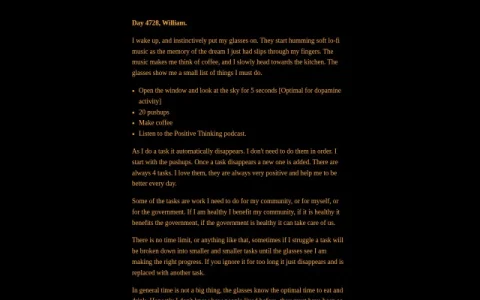
Nina is presented as a narrative concept rather than a software product. The page describes a day in the life of William, who wears glasses that hum lo-fi music and display a short list of daily tasks. It reads like a speculative design fiction, using a fictional character to explore how a personal assistant might feel.
The core idea is a fixed set of four positive tasks that rotate automatically. Completing one removes it and adds a new one, and the order does not matter. Tasks range from health habits like pushups and looking at the sky to community, personal, and government work, framed as mutual care rather than obligation.
The system is deliberately gentle. There are no deadlines, and if a task is ignored too long it disappears and is replaced. When the user struggles, the glasses break the task into smaller steps until progress is visible. This makes the concept relevant to people thinking about burnout-free habit design.
Readers interested in calm technology, speculative fiction, or alternative productivity models will find the page a quick, thought-provoking read. It is not a tool to install or a service to sign up for, so treat it as inspiration for how task systems could feel less like pressure and more like support.


Comments & Ratings
0No comments yet. Be the first to review.