
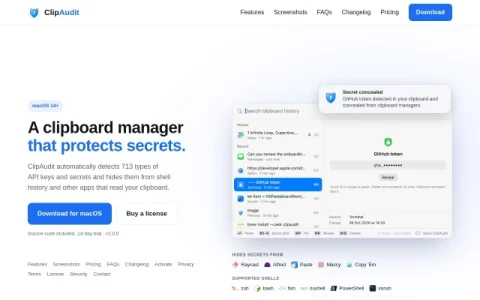
ClipAudit positions itself as a clipboard manager with a security-first angle. Rather than only storing a history of copied items, it inspects clipboard contents and identifies credentials such as GitHub tokens and API keys before other software can read them. The stated goal is to keep secrets out of shell history and out of the logs of clipboard utilities that run in the background.
The core mechanism is pattern detection across 713 types of API keys and secrets. When a match appears, ClipAudit conceals the value from clipboard managers including Raycast, Alfred, Paste, Maccy, and Copy ‘Em, and it also covers shell environments such as zsh, bash, fish, nushell, PowerShell, and xonsh. The site provides screenshots, a changelog, and FAQs documenting how detection behaves.
It is aimed at developers, DevOps engineers, and system administrators who routinely copy tokens, connection strings, and passwords between terminals, dashboards, and editors. Anyone who has pasted a key into a shell by accident, or who runs a clipboard history tool alongside sensitive work, is the intended audience.
Practical notes: the app requires macOS 14 or later, offers a 14-day trial, and is sold as a paid license that includes source code. Downloads are delivered by email link rather than a direct installer. Users should confirm that their particular clipboard manager and shell combination is covered before relying on it.
Overall, ClipAudit is a narrow but well-defined utility for Mac users who w


Comments & Ratings
0No comments yet. Be the first to review.