

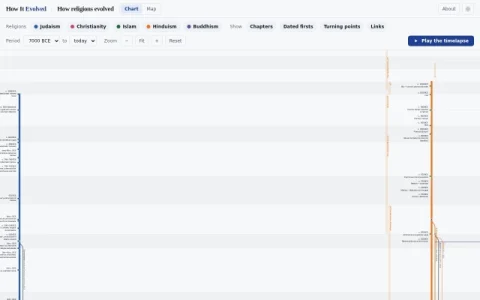
How It Evolved is a history visualization project that presents the development of five major religious traditions on a single chart. Rather than telling the story in paragraphs, it arranges Judaism, Christianity, Islam, Hinduism and Buddhism as branching lineages across a 9,000-year span, so that shared roots, splits and later offshoots can be compared side by side.
The chart carries 180 dated firsts and roughly 140 branches and schisms. Each entry is dated by its first surviving evidence instead of by traditional founding dates, and every point links to the chapter that cites the underlying source. A timelapse control plays the branching year by year, while the time axis is compressed so that busy periods take up more vertical space than quiet ones.
Readers can filter by tradition, toggle chapters and turning points, and switch between chart and map views. Hovering reveals the supporting evidence behind a date. A free poster version is offered under a CC BY license, which suits classrooms, reading groups and anyone who wants the overview on a wall.
It is aimed at students of religious history, teachers preparing comparative lessons, and general readers who prefer a structural overview before diving into detail. Because dates reflect surviving evidence, some entries will differ from conventional accounts, so treat the chart as a starting point and follow the citations for context.


Comments & Ratings
0No comments yet. Be the first to review.