

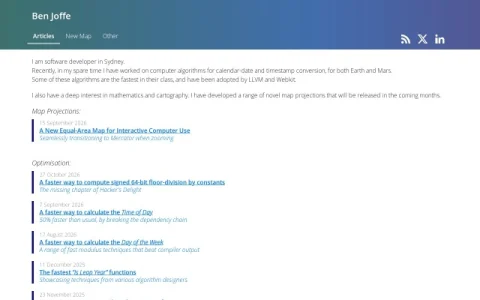
BenJoffe.com is the personal site of Ben Joffe, a software developer based in Sydney. Rather than a portfolio or blog about general programming, it functions as a working notebook where finished research is published: fast algorithms for calendar-date and timestamp conversion, mathematical explorations, and cartography experiments. The tone is technical and understated, aimed at readers who want the actual method rather than an overview.
The core of the site is a series of optimisation articles. Posts cover a faster way to compute signed 64-bit floor-division by constants, a time-of-day calculation roughly 50% faster than usual by breaking the dependency chain, fast day-of-the-week and leap-year functions, and a 64-bit date algorithm using only four multiplications. Some of these algorithms are described as the fastest in their class and have been adopted by LLVM and WebKit, which gives the archive unusual practical weight.
A second thread is map projections. Joffe presents a new equal-area map designed for interactive computer use that transitions seamlessly to Mercator when zooming, with further projections promised. The site also links out to an RSS feed, X, and LinkedIn, so readers can follow new posts without checking back manually.
This material suits software developers working on date handling, compilers, or performance-sensitive code, as well as students of mathematics and cartography interested in projection design. Readers should expect dense, assumption-heavy w


Comments & Ratings
0No comments yet. Be the first to review.