
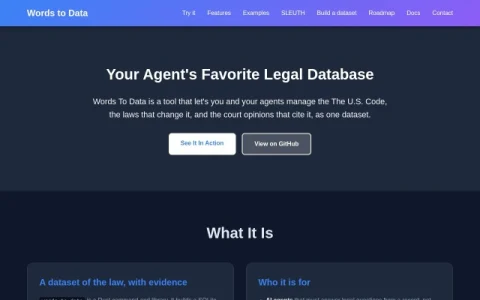
Words to Data is a Rust command-line tool and library that assembles a SQLite dataset from public legal sources. Rather than offering a search interface, it produces a structured record of the U.S. Code at chosen release points, the public laws that amend it, and court opinions that cite it. The project positions itself as infrastructure for agents that must answer from a record rather than from memory.
The core mechanism is rule-based extraction. Links between amendments and the sections they change, and between court citations and the provisions cited, are built from the publisher’s own markup. No language model writes a link. When the rules cannot place an amendment, it is placed on a work list with the reason recorded, so gaps remain visible instead of being filled speculatively.
The dataset also includes CourtListener opinions segmented by page and paragraph, and can hold House roll calls. Each answer is designed to come with quotable text and an address to check, which supports verification rather than trust. The project publishes a roadmap, documentation, and example workflows, and the code is available on GitHub.
It suits AI engineers building legal research agents, data teams assembling citation graphs, and analysts who need to audit how a statute changed over time. Researchers who want a ready-made search product may find it too low-level, since it expects users to run commands and manage their own dataset builds.
A practical approach is to start with a single C


Comentarios y valoraciones
0Aún no hay comentarios. Sé el primero en valorar.