
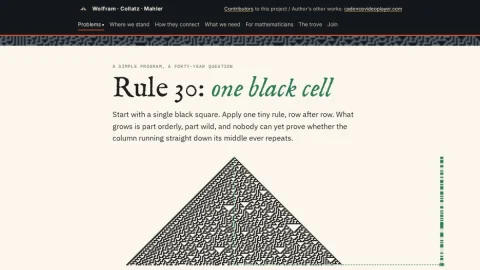
This page is a single-topic explainer built around one of the simplest programs in Wolfram’s work: Rule 30, which begins with one black cell and grows row by row. Rather than surveying cellular automata broadly, it stays with this rule and walks through what makes its output partly orderly and partly wild.
The core of the explanation is the rule itself. Each new square looks at three squares above it, and those three colours form eight possible combinations; the eight resulting answers, written as a binary number, give 00011110, or 30. The page shows this lookup concretely so the rule can be followed by hand, then lets the generated pattern build up visually.
A green column runs down the middle of the growing triangle, and as each row appears its middle cell is read into a strip on the right. So far that strip looks like fair coin tosses, which is exactly the behaviour Wolfram’s prize questions ask about; the page also notes where five days of work on his first prize question currently stands.
It suits curious readers, students, and programmers who want an intuitive entry point before reading formal treatments, and it works well as a first stop followed by the linked problem pages. Read the rule section first, then watch the middle column accumulate.


Comments & Ratings
0No comments yet. Be the first to review.