
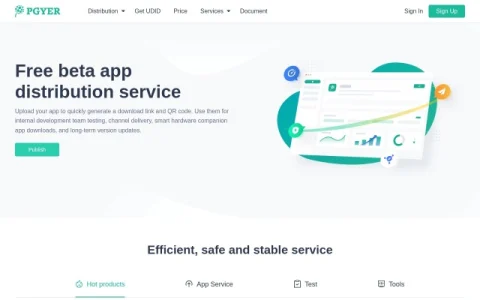
PGYER positions itself as an internal testing and beta distribution service aimed primarily at mobile developers in China. Instead of sending builds through email or cloud drives, teams upload an iOS or Android package and receive a shareable install page that testers can open on their devices.
The core workflow covers app upload, version management, and tester access through links or QR codes. Around it, PGYER adds practical helpers: one-step iOS UDID retrieval, an Open API, a Mac uploader, Fastlane and Jenkins plugins, online icon and launch-image cropping, plist generation, and QR codes for text, URLs, and documents.
It also lists adjacent services such as bug hunting reports, compatibility testing on popular devices, enterprise security checks, app hardening, privacy compliance review, ICP filing, and Android uploads to major app stores. These extend the platform beyond pure distribution into release preparation.
Typical users are indie developers, QA teams, and mobile engineering groups that need fast internal builds without building their own distribution infrastructure. Teams already using CI pipelines benefit most from the plugin and API support.
A sensible approach is to start with free hosting and distribution, then adopt the auxiliary tools only as release needs grow. PGYER works best as a lightweight distribution hub rather than a full DevOps suite.


Comments & Ratings
0No comments yet. Be the first to review.