

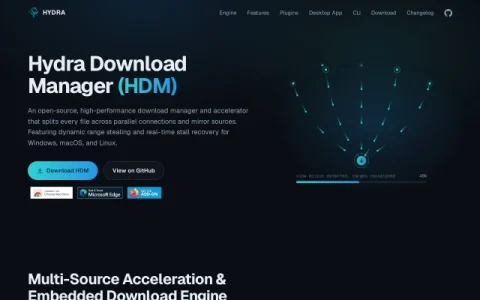
Hydra Download Manager (HDM) positions itself as a high-performance, open-source download engine rather than a simple downloader. Its core is a statistical scheduler for byte ranges, packaged behind a frozen C ABI called libhydra, so the same engine can power a desktop app, a CLI, or a third-party application. It runs on Windows, macOS, and Linux.
The feature set centers on multi-source acceleration: parallel HTTP/S and FTP streams are drained from multiple mirrors at once, with per-server concurrency ramping up automatically. Dynamic range stealing detects slow connections mid-flight and reassigns their remaining byte ranges to faster peers. A CUSUM-based estimator flags collapsing connections seconds before ordinary socket timeouts, and integrity is handled through per-chunk checksum manifests, Content-MD5 validation, and local Reed-Solomon erasure coding.
Because of that architecture, HDM is aimed at technically comfortable users: developers who want to embed a download engine via libhydra, power users who prefer a CLI, and anyone routinely pulling large files from several mirrors. Casual users looking for a one-click browser downloader may find the project’s framing more engineering-oriented than they need.
A practical approach is to start with the desktop app or CLI to test multi-source behavior on a large file, then consult the plugins and engine documentation if you plan to integrate libhydra. Checking the changelog before upgrading is worthwhile given the active de

Comments & Ratings
0No comments yet. Be the first to review.