

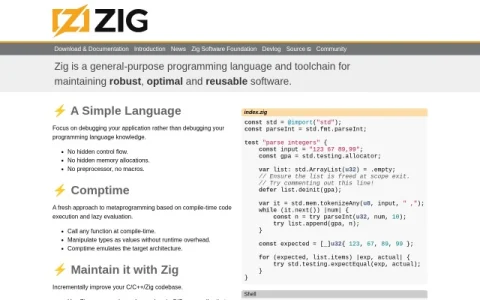
Zig positions itself as a general-purpose programming language and toolchain aimed at maintaining robust, optimal, and reusable software. Rather than adding layers of abstraction, it focuses on making the programmer’s intent explicit, so debugging effort goes into the application instead of into surprises caused by the language itself.
The language emphasizes simplicity: there is no hidden control flow, no hidden memory allocations, no preprocessor, and no macros. Metaprogramming is handled through comptime, a compile-time code execution model with lazy evaluation that lets developers call functions and manipulate types as values without runtime overhead.
A major practical feature is the ability to work with existing C/C++ code. Zig can act as a zero-dependency, drop-in C/C++ compiler with out-of-the-box cross-compilation, and zig build provides a consistent development environment across platforms. Developers can also add a Zig compilation unit to C/C++ projects to access its standard library.
Zig is best suited to systems programmers, C/C++ developers evaluating incremental migration, and learners interested in a transparent language design. Newcomers should start with the official documentation and code samples, then try the toolchain on a small project to understand comptime and the build system before committing to larger codebases.


Comments & Ratings
0No comments yet. Be the first to review.